Could Florida Amendment 3 Raise Home Values? What Property Tax Reform Could Mean for Palm Beach County Real Estate
Lower Property Taxes Could Change More Than Annual Tax Bills
Florida property taxes have become one of the biggest real estate topics of 2026.
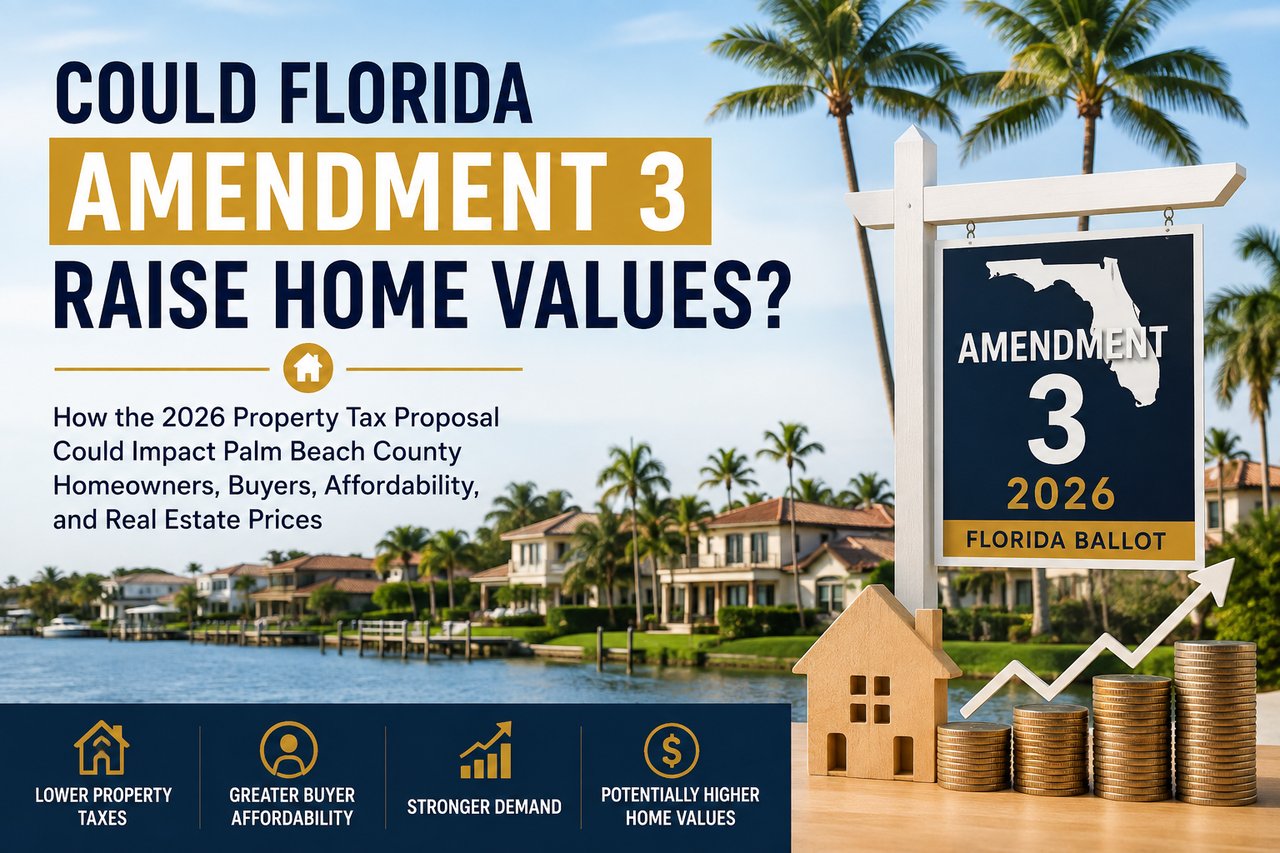
And as Florida voters prepare to consider Amendment 3 in November, homeowners are asking a question that goes beyond simply saving money on their tax bill:
Could lower property taxes actually increase Florida home values?
The answer is potentially yes, but it is more complicated than saying that every Florida home would suddenly become worth more.
If Amendment 3 passes, the proposal could meaningfully reduce the annual carrying cost of a homesteaded primary residence for many existing Florida residents. Lower ownership costs can affect affordability, buyer demand, how much purchasers are willing to pay and even whether existing homeowners decide to sell.
All of those factors can influence real estate values.
For Palm Beach County homeowners in Wellington, Loxahatchee, Westlake, Palm Beach Gardens, Jupiter, Boca Raton, West Palm Beach and surrounding communities, Amendment 3 is worth watching closely.
What Is Florida Amendment 3?
Florida Amendment 3 is a proposed constitutional amendment scheduled for the November 3, 2026 general election.
Under the proposal, Florida's homestead exemption for non-school property taxes would increase substantially.
If approved:
- The exemption would increase to $150,000 beginning January 1, 2027
- It would increase again to $250,000 beginning January 1, 2028
- Beginning in 2029, the exemption would be adjusted for positive inflation
- School district property taxes would remain subject to a separate $25,000 exemption
- The annual assessment increase cap on many non-homestead properties would fall from 10% to 5%
Florida constitutional amendments require at least 60% voter approval to pass.
This is important: Amendment 3 does not simply eliminate all Florida property taxes.
School district taxes would remain, and local property tax rates and other fees could still change.
For a broader explanation of the proposal, see my Florida Homestead Tax Proposal 2026 guide.
Why You May Have Seen a Different Name for Amendment 3
Earlier in 2026, the proposal was frequently called the “Save Our Homes from Excessive Property Taxes” amendment.
That wording changed.
On August 3, 2026, a Leon County Circuit Court judge ruled that the original ballot title and summary were not sufficiently neutral and ordered the language rewritten.
The revised title is:
“Increased Homestead Exemption; Lower Cap on Increases in Non-Homestead Property Assessments.”
The policy itself remains scheduled for the November ballot.
This distinction matters because homeowners researching the proposal online may encounter both names.
So, Could Amendment 3 Increase Florida Home Values?
Potentially.
There is an established economic concept known as property tax capitalization.
In simple terms, buyers do not evaluate a home based solely on its purchase price.
They also consider the ongoing cost of owning it:
- Mortgage payment
- Property taxes
- Homeowners insurance
- HOA or community fees
- Maintenance
- Utilities
- Other recurring expenses
When one of those expenses permanently decreases, the property can become more financially attractive.
Research has found evidence that property tax differences can become partially incorporated, or “capitalized,” into home prices.
The Federal Reserve Bank of Minneapolis has explained the concept from the opposite direction: higher expected property taxes can become reflected in lower purchase prices because buyers account for those future costs when deciding what they are willing to pay.
Research using Dallas County housing data has similarly found substantial capitalization of property tax differences into property values.
That does not mean we can take a homeowner's annual Amendment 3 savings, multiply it by a certain number and predict exactly how much their Palm Beach County home will appreciate.
But economically, there is a reasonable case that permanently lowering the ownership cost of a property could support higher values.
Think About a Home Through the Buyer's Monthly Budget
Most financed buyers do not begin their home search by saying:
“I can spend exactly $700,000.”
They are often thinking:
“What monthly payment can I comfortably afford?”
That payment includes more than principal and interest.
Property taxes can represent hundreds or even thousands of dollars per month depending on the property.
If the tax component decreases, a buyer potentially has more room within the same monthly housing budget.
For example, Florida TaxWatch estimates that using a statewide average non-school property tax rate of approximately $10.50 per $1,000 of taxable value, homes assessed above $250,000 could potentially save approximately:
- $1,035 annually in 2027
- $2,085 annually in 2028
That is roughly $86 per month in 2027 and $174 per month in 2028.
Actual Palm Beach County savings would vary significantly based on assessed value, municipality, taxing districts, exemptions and local millage rates.
But from a real estate perspective, the concept is important.
Reducing a home's recurring ownership expense can increase its relative affordability.
Lower Taxes Could Increase What Some Buyers Are Willing to Pay
Consider two otherwise comparable homes.
One costs $750,000 but carries substantially higher annual property taxes.
The other costs $750,000 with significantly lower taxes.
Assuming everything else is equal, many buyers would prefer the property with the lower long-term ownership cost.
Taken across an entire market, lower recurring taxes could allow buyers to allocate more of their housing budget toward the home's purchase price.
That creates one pathway through which Amendment 3 could potentially support Florida property values.
Research on homestead exemptions specifically has also modeled this effect. A 2024 study published in Public Budgeting & Finance found that some of the value of homestead tax savings can theoretically be reflected in higher property values, although the magnitude depends heavily on tax rates, exemption sizes and other assumptions.
There Could Also Be an Inventory Effect
There is another possibility that may matter just as much in Palm Beach County.
Lower property taxes could encourage some homeowners to stay in their homes longer.
That is especially relevant to owners who already:
- Have a low mortgage rate
- Have substantial equity
- Benefit from Save Our Homes
- Have a paid-off mortgage
- Have no strong reason to relocate
If their annual property tax burden also decreases, the financial incentive to remain in the property becomes even stronger.
Recent economic research has examined this type of housing “lock-in” effect and found that lower property taxes can encourage longer ownership periods.
For the real estate market, that creates an interesting possibility.
If fewer owners decide to sell while buyer demand remains stable, available inventory could tighten.
And lower inventory can support home prices.
That could be particularly meaningful in parts of Palm Beach County where desirable single-family inventory is already limited.
In fact, Palm Beach County's July 2026 market data showed single-family inventory down 23% compared with July 2025 while closed sales increased 13%.
Read my full Palm Beach County Real Estate Market Update for July 2026 for more on current inventory, prices and buyer activity.
But There Is a Major Catch for People Moving to Florida
One of the most important parts of Amendment 3 is especially relevant to Palm Beach County because of the area's relocation market.
The larger exemption would not immediately apply to everyone who moves into Florida after 2026.
Under the proposal, people who were not permanent Florida residents as of December 31, 2026 would initially receive a $50,000 exemption against non-school taxes after qualifying for homestead.
They generally would not receive the larger exemption until the fifth year of eligibility.
Beginning in 2030, local governments could potentially shorten that waiting period to address certain critical local needs.
That makes the possible housing-market impact more complicated.
An existing Florida resident moving from one Palm Beach County home to another could be in a very different tax position from someone relocating from New York, New Jersey, California or another state.
For Palm Beach County buyers, understanding that difference could become an important part of calculating the actual cost of purchasing a home.
If you are considering purchasing locally, my Palm Beach County home-buying resources can help you begin comparing the complete cost of ownership.
What About Second Homes, Rentals and Investment Properties?
The larger homestead exemption is focused on qualifying primary residences.
Second homes, vacation properties and investment properties would not receive the same expanded homestead exemption.
However, Amendment 3 contains another provision that could matter to investors.
The proposal would reduce the maximum annual increase in assessed value for many non-homestead properties from 10% to 5%, excluding school district levies.
That could provide additional assessment protection over time for certain:
- Rental properties
- Second homes
- Vacation homes
- Commercial properties
- Investment properties
Again, that does not mean the tax bill itself could only increase 5%. The provision deals with assessment growth, while tax rates can also change.
Could Amendment 3 Actually Make Homes More Expensive for Buyers?
There is a real possibility that some portion of the tax savings eventually becomes reflected in higher purchase prices.
That creates an interesting real estate tradeoff.
A buyer might receive:
Lower annual property taxes
while simultaneously facing:
A somewhat higher home price because other buyers value those same tax savings.
This is the same property-tax capitalization effect working in reverse.
Lower ownership costs can make real estate more desirable, and more desirable assets can command higher prices.
That does not automatically make buyers worse off.
A purchase price is largely a one-time acquisition cost that can be financed, while property taxes continue every year the home is owned.
Different buyers will value that tradeoff differently.
Why Amendment 3 May Not Raise Values Everywhere
There are also several reasons homeowners should avoid assuming Amendment 3 automatically means higher property values.
1. School Property Taxes Would Remain
The expanded exemption applies to non-school taxes.
Florida TaxWatch estimates school-related property taxes account for roughly 40% of the average property tax bill.
So homeowners would not suddenly have a zero tax bill.
2. Local Governments Could Adjust Tax Rates
Amendment 3 does not freeze local millage rates.
Counties, municipalities and other taxing authorities could potentially make changes within existing legal limits.
3. Governments Could Increase Other Fees
Local governments could also look toward other taxes, assessments or fees to replace some lost revenue.
That could reduce the net savings homeowners ultimately experience.
4. Public Services Also Influence Property Values
Property values are influenced by more than taxes.
Infrastructure, roads, parks, public safety, flood mitigation and other local services can all affect how desirable an area is.
The Tax Foundation has raised concerns that significant reductions in property tax revenue could force difficult decisions regarding local spending or alternative sources of revenue.
Florida TaxWatch similarly notes that state economists project substantial recurring reductions in local property tax revenue if the amendment takes effect.
Those potential consequences need to be considered alongside the direct tax savings.
Why This Could Matter More in Palm Beach County
Palm Beach County has a particularly interesting combination of factors:
- High-value residential real estate
- Significant primary-home ownership
- Luxury properties
- Retirement and downsizing demand
- In-state buyers
- Out-of-state relocation buyers
- Second-home ownership
- Investment properties
- New construction
- Gated and country club communities
That means Amendment 3 could affect different buyers very differently.
A long-time homesteaded homeowner in Wellington could have a very different outcome from a New York buyer purchasing a $2 million home in Palm Beach Gardens.
An investor purchasing a rental in West Palm Beach could have a different benefit from a family buying its primary residence in Westlake.
And a homeowner in Loxahatchee with a lower assessed value could see the expanded exemption affect a much larger percentage of the home's taxable value.
That is why the real estate implications need to be evaluated property by property.
Explore my Palm Beach County community and neighborhood guides to compare different areas throughout the county.
What Could Amendment 3 Mean for Palm Beach County Sellers?
If Amendment 3 passes, homeowners considering selling should pay attention to how buyers begin factoring property taxes into their purchasing decisions.
Potential seller advantages could include:
- Greater attractiveness of Florida homeownership
- Lower projected carrying costs for some buyers
- Increased purchasing power
- Stronger demand for homestead-eligible residences
- Reduced future inventory if existing owners choose to stay longer
- Potential capitalization of tax savings into home prices
But none of these outcomes are guaranteed.
Interest rates, insurance costs, economic conditions, inventory, supply, buyer migration and local market conditions will continue to have a much larger role in determining the value of an individual property.
If you are curious about your property's current market position, you can start with my Palm Beach County home valuation tool.
What Could Amendment 3 Mean for Buyers?
For buyers, Amendment 3 makes one point especially important:
Do not evaluate a Florida property using the seller's current tax bill.
Florida homes can be reassessed following a change of ownership, and the buyer's exemptions, portability, residency status and assessed value can create a very different future tax bill.
Amendment 3 could add another layer to that calculation.
Buyers should look at:
- Estimated future assessed value
- Homestead eligibility
- Florida residency date
- Save Our Homes portability
- Local millage rates
- School taxes
- HOA or community fees
- Insurance
- CDD assessments where applicable
- Total estimated monthly housing cost
The purchase price is only one component of affordability.
Florida Realtors Has Announced Support for Amendment 3
In August 2026, Florida Realtors announced that its Board of Directors had voted to support Amendment 3, stating that it believes the measure could provide meaningful property tax relief and support attainable homeownership.
Other organizations have raised concerns about the potential impact on local government revenues and public services.
Florida TaxWatch, which does not endorse or oppose ballot measures, lists organizations publicly supporting the proposal as well as organizations that have expressed opposition or significant concerns.
That debate is likely to continue as the November election approaches.
The Bottom Line: Amendment 3 Could Affect Home Values, But Not in a Vacuum
Could Florida Amendment 3 raise home values?
It could contribute to higher values in some segments of the market.
Reducing the recurring cost of owning a home can make real estate more attractive and increase what buyers are willing or able to pay.
Lower taxes could also encourage existing homeowners to stay in their homes longer, potentially reducing resale inventory.
Both effects could support prices.
But Amendment 3 would not operate in isolation.
Mortgage rates, homeowners insurance, local taxes and fees, inventory, population growth, economic conditions and the quality of local services will continue to influence Florida real estate.
There is also the important five-year distinction for many new Florida residents, meaning the proposal's benefits would not be evenly distributed across every buyer.
For Palm Beach County, I believe this is a policy worth following closely because property taxes are an important component of the cost of homeownership.
As we get closer to November, the conversation will increasingly shift from “How much could homeowners save?” to an even larger question:
“How could those savings change buyer behavior, housing inventory and property values?”
That is where the real estate impact could become particularly interesting.
Frequently Asked Questions About Florida Amendment 3 and Real Estate
Is Florida Amendment 3 already law?
No. Amendment 3 is scheduled to appear on Florida's November 3, 2026 ballot and requires at least 60% voter approval.
When would Amendment 3 take effect?
If approved, the amendment is scheduled to take effect January 1, 2027.
Would Amendment 3 eliminate Florida property taxes?
No. School district property taxes would remain, and the amendment itself does not eliminate every property tax on a homesteaded residence.
What would the homestead exemption be in 2027?
For qualifying residents covered by the expanded exemption, it would increase to $150,000 for non-school levies in 2027.
What would the Florida homestead exemption be in 2028?
The proposed non-school homestead exemption would increase to $250,000 beginning in 2028 and would be indexed for positive inflation beginning in 2029.
Would someone moving to Florida in 2027 immediately receive the $250,000 exemption?
Generally, no. People who were not permanent Florida residents as of December 31, 2026 would initially receive the existing $50,000 non-school exemption and generally become eligible for the larger exemption beginning with their fifth year of eligibility.
Could Amendment 3 increase Florida home prices?
Potentially. Lower recurring property tax costs can increase a property's financial attractiveness, and economic research shows that property tax differences can become partially reflected in housing prices. The actual effect in Florida cannot be known in advance and would vary by market and property.
Would Amendment 3 help rental or investment property owners?
Rental and investment properties would not qualify for the expanded homestead exemption, but the proposal would reduce the annual non-homestead assessment increase cap from 10% to 5% for applicable non-school levies.
Stay Informed About Palm Beach County Real Estate
Major tax changes can affect much more than an annual property tax bill.
They can influence affordability, buyer demand, inventory, relocation decisions and potentially property values.
I will continue following Amendment 3 and its potential impact on Palm Beach County homeowners and buyers as the November vote approaches.
I am Victor Velazco, REALTOR® with Echo Fine Properties, a full-time bilingual real estate advisor serving Wellington, Loxahatchee, Westlake, Palm Beach Gardens and communities throughout Palm Beach County and South Florida.
If you are considering buying, selling or simply want to understand what your home could be worth in today's market, I can help you evaluate the numbers based on your specific property and goals.
This article is provided for general real estate and educational purposes only and should not be considered legal, tax or financial advice. Property tax laws, exemptions and individual circumstances can vary. Consult the appropriate tax or legal professional regarding your specific situation.